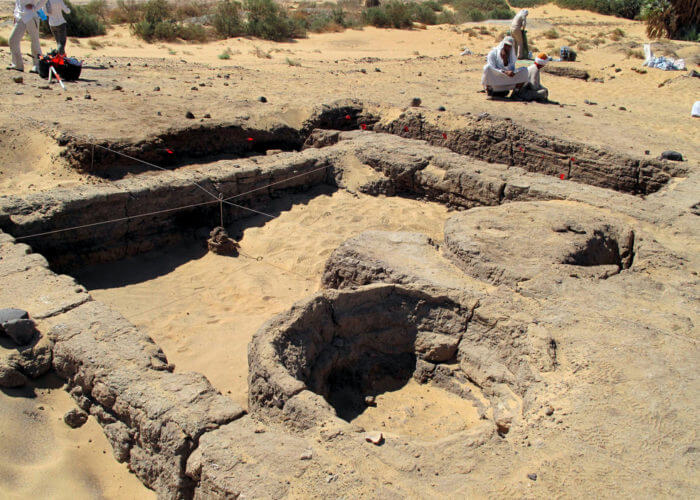
The American-Egyptian mission from Yale University has stumbled upon what appears to be the remains of a substantial settlement. The city is a thousand years earlier than the major surviving ancient remains at the Umm Mawagir area in Kharga Oasis.
Minister of Culture, Farouk Hosny, announced that the settlement is dated to the Second Intermediate Period (ca.1650-1550 BC) and was discovered during excavation work as part of the Theban Desert Road Survey. This project serves to investigate and map the ancient desert routes in the Western desert.
Dr. Zahi Hawass, Secretary General of the Supreme Council of Antiquities (SCA), said that the newly discovered settlement is 1km long from north to south and 250m wide from east to west. It lies along the bustling caravan routes connecting the Nile Valley of Egypt and the western oasis with points as far as Darfur in western Sudan. Hawass continued that archaeological evidence at the site indicated that its inhabitants were part of an administrative center and they were engaged in baking on a massive scale.